A brushless motor uses electronic switching instead of brushes and a mechanical commutator. In a typical cordless-tool design, a controller energizes stationary windings to turn a permanent-magnet rotor.
This removes brush wear and gives designers useful control over motor operation. It does not guarantee a particular runtime, lifespan or power output. Buyers should compare complete tools under a defined workload, not treat “brushless” as a performance rating.
What changes inside a brushless motor?
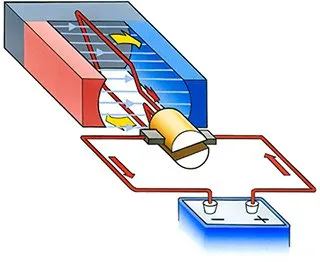
In a conventional permanent-magnet brushed DC motor, brushes transfer current through a rotating commutator into rotor windings. Rotation changes the electrical connections, keeping torque acting in the required direction.
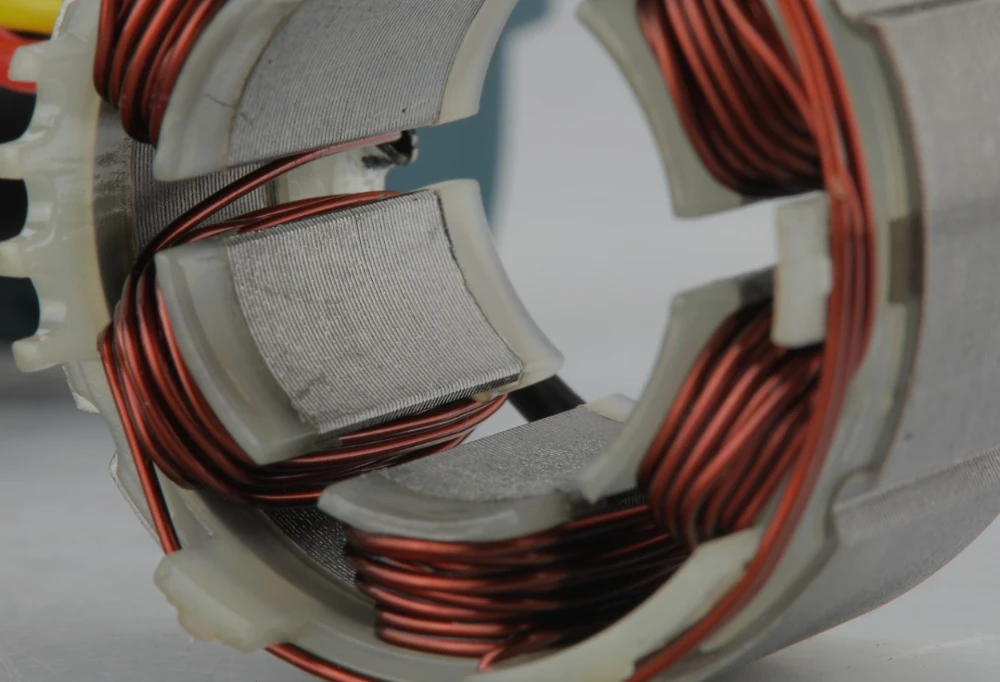
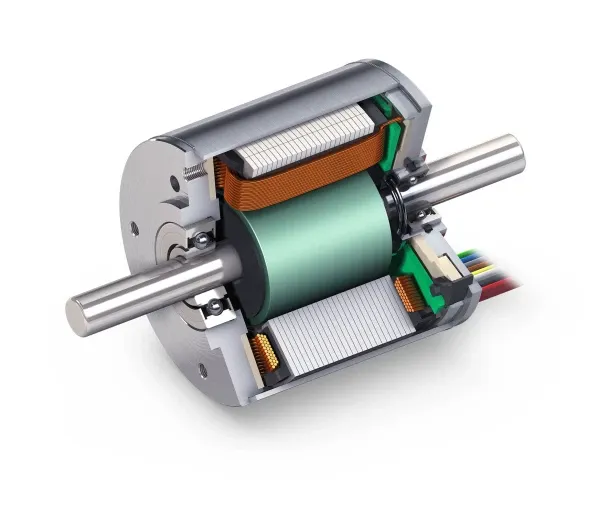
A typical brushless DC motor places the windings on the stationary stator and permanent magnets on the rotor. Electronics perform the switching. The rotor still runs on bearings, so “no brushes” does not mean “no friction” or “no moving parts.”
Renesas explains this arrangement in its brushless DC motor overview. Our brushed motor guide covers the alternative in more detail.
- The stator carries the stationary windings.
- The rotor turns the shaft.
- The controller switches current through the windings.
- Bearings support rotation and remain wear components.
How does electronic commutation keep it turning?
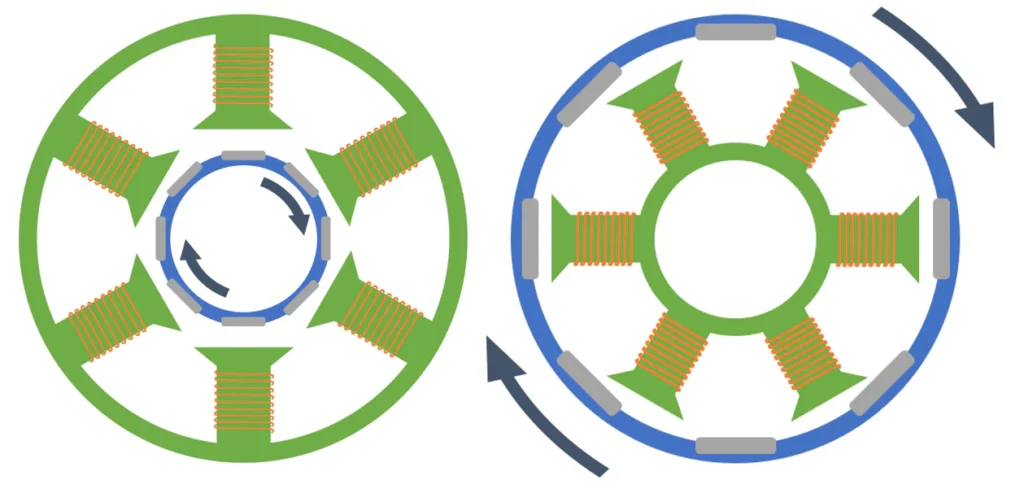
The controller energizes winding phases in a sequence coordinated with rotor position. The resulting magnetic interaction produces torque. Changing current and switching timing controls operation within the system’s limits.
Some systems use rotor-position sensors. Others estimate position from electrical behavior. Renesas describes both approaches in its BLDC control explanation. Sensorless does not mean uncontrolled, and brushless does not mean every tool contains Hall sensors.
The controller is part of the motor system. Its current limits, cooling and control strategy affect starting behavior and sustained work. A motor specification without controller information cannot describe the finished tool.
Brushed tools can also have electronic speed control and protection. Do not assume these features belong exclusively to brushless models. Verify functions on the exact product.
Compare benefits without turning them into guarantees
Removing brush contact eliminates one source of electrical loss, mechanical friction and wear. Brushless designs can use that advantage for efficiency, compactness or useful output. The result depends on design choices and operating conditions.
| Question | Brushed design | Brushless design |
|---|---|---|
| How is current switched? | Brushes and commutator | Electronic controller |
| What wear point changes? | Brush contact requires attention | No brushes to replace |
| Is efficiency fixed? | No; varies with design and load | No; controller and motor losses remain |
| What must be checked for repair? | Brush availability and wider tool condition | Motor/controller parts and diagnostic support |
| Does the label establish power? | No | No |
Keep the comparison at tool level. A compact brushless driver should not be expected to outperform a larger brushed tool on every task. Gear reduction, battery output, accessory selection and protection limits also matter.
Tool category comes first. Our impact-driver and drill comparison explains why similar motor labels can accompany very different mechanisms.
Distinguish efficiency, runtime and battery lifespan
Efficiency describes useful output relative to input under stated conditions. Runtime describes operation on one charge. Battery lifespan concerns deterioration over repeated use and time. These terms answer different questions.
A more efficient system may complete more work using the same stored energy. It may instead be configured to deliver higher output. Either choice prevents a universal claim such as “all brushless tools run 35% longer.”
Measure useful work, not just minutes spinning freely. Specify material, accessory, pack model, charge state and stopping criteria. Record acceptable holes, fasteners or cuts completed, together with interruptions.
Our cordless chainsaw runtime guide illustrates why application conditions matter. Its numbers should not be transferred to a drill or grinder.
- Compare equivalent battery configurations.
- Repeat representative tasks within rated limits.
- Report conditions alongside any percentage claim.
Match motor features to the actual tool
Drills need suitable low-speed control, gearing and approved drilling capacity. Impact drivers add a rotary impact mechanism, so their peak torque figures should not be read as continuous motor torque or final fastening accuracy.
For fastening work, the impact driver user guide covers bits, modes and control. Brushless construction does not convert an impact driver into a calibrated torque tool.
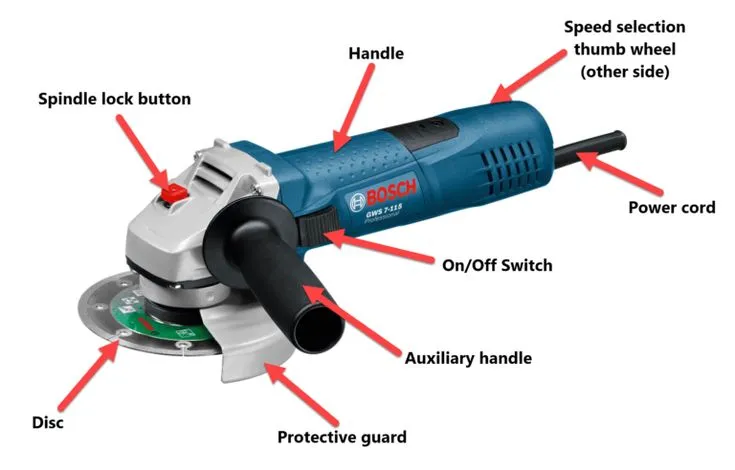
Grinders place different demands on accessory speed, guarding and sustained load. Start with our angle grinder selection guide before comparing motor labels.
For surface finishing, motion type, pad format, abrasive and dust collection can outweigh the motor label. The power sander guide explains those choices.
Ask which limitation an upgrade solves. If poor results come from a wrong blade, worn abrasive or unsuitable tool category, changing motor technology may not fix them.
Understand what brushless does not remove
Brushless tools still generate heat. Windings, bearings, gears, power electronics and batteries have operating limits. Cooling paths can become obstructed, and repeated protection trips need investigation rather than repeated forced restarts.
Removing brush arcing does not make a complete tool safe in an explosive atmosphere. Switches, contacts, hot surfaces and workpiece sparks may remain ignition sources. Use only equipment approved for the assessed environment.
It is not a waterproofing specification either. Check the manufacturer’s environmental limits. Do not infer dust sealing, moisture resistance or suitability for wet cutting from the motor type.
- Follow the manual’s inspection and cleaning instructions.
- Isolate power before permitted maintenance.
- Do not bypass thermal, current or battery protection.
- Stop using damaged or abnormally behaving equipment.
Compare maintenance and repair access honestly
A brushed motor may need replacement brushes where the design permits servicing. Worn brushes are not its only possible fault. Bearings, windings, switches and gear assemblies can also require attention.
A brushless motor removes brush replacement but adds dependence on electronic commutation. Whether a faulty controller is separately replaceable depends on the model and available service parts.
No universal service-life figure applies. Claims of 10,000 hours or three times longer life need a defined test, failure criterion and comparable configurations. Motor endurance is not automatically the lifespan of the complete tool.
Before buying, request the service route and relevant parts list. Confirm who performs diagnosis, which assemblies are available and what the warranty excludes. Do not open a tool or lubricate sealed components without an approved procedure.
Decide whether the extra cost earns its place
For occasional use, a suitable brushed tool may meet the job at a lower purchase price. Existing compatible batteries and accessible repair support can strengthen that choice. There is no need to replace a functioning tool solely because its motor has brushes.
Frequent users may gain more from a brushless model’s demonstrated runtime, size or workload capability. Those gains should be measured against the actual alternative. A higher price is justified by useful benefits, not terminology.
| Cost or benefit | Evidence to use |
|---|---|
| Initial difference | Equivalent complete-kit quotations |
| Battery requirement | Packs and charging needed for the work cycle |
| Maintenance | Model-specific service needs and parts prices |
| Downtime | Recorded interruptions and actual repair arrangements |
| Output benefit | Acceptable work completed under matched conditions |
| Replacement exposure | Relevant reliability records, not assumed lifespan multipliers |
If reliable cost or failure data is unavailable, show a range of assumptions. Do not present a precise payback month as a measured result.
Specify the whole system for distribution or private label
A distributor’s decision also includes customer expectations, service capability and the claims printed on packaging. “Brushless” can identify construction; runtime and durability statements need separate support.
For a cordless-tool supply inquiry, describe the application and target kit. Request matching motor, controller, battery, charger and test information for the proposed model.
Keep approved samples tied to the production specification. Agree how material component changes are reviewed. A visually identical controller or battery substitution can change behavior without changing the outer housing.
For private-label customization, include instructions, artwork and claim approval in the project scope. Switching an existing brushed design to brushless requires engineering evaluation; it is not a routine drop-in motor replacement.
Questions to resolve before choosing brushless
The useful choice is the tool that performs your approved task, fits your battery and service arrangements, and has evidence behind its claims. Motor technology helps explain the design. It does not replace those checks.
Is a brushless motor always more powerful?
No. Output depends on the complete motor, controller, power supply and tool design. Compare rated capabilities and representative work.
Does brushless mean maintenance-free?
No. There are no brushes to replace, but the tool still requires prescribed inspection, cleaning and servicing.
Does every brushless motor use Hall sensors?
No. Some systems use sensors; others estimate rotor position electrically. The control method is a design choice.
How much longer will a brushless tool run?
No universal percentage applies. Compare the exact tools and packs on the same task, including finish and interruption criteria.
Should I upgrade a working brushed tool?
Only if the replacement offers a useful, verified benefit for your work. Include battery compatibility, purchase cost and repair support.